
Fragmented context
The company keeps re-explaining itself across apps, inboxes, operators, and reports.
AIMXB Intelligence Platform
AIMXB maps the business as connected objects, policies, actions, and history. Teams and agents act through that model instead of bouncing between disconnected tools, reports, and surfaces.
Your systems. Your data. One governed model.
Operational sources
AIMXB-LAM operating model
The business is represented as connected objects, links, permissions, actions, and history so every interface and workflow acts on the same reality.
Products and operator surfaces
Operating Pressure
The company keeps re-explaining itself across apps, inboxes, operators, and reports.
Approvals, workflows, and agents move without enough shared state because the model is missing underneath them.
Every new portal, workspace, or app launches as another disconnected edge instead of extending the operating core.
Why AIMXB
AIMXB closes the gap between raw systems and governed action by keeping context, logic, and security inside one operating layer.
Define the connected business objects, states, obligations, and ownership the company actually runs on.
Pull records, events, documents, and workflows into one governed operating layer.
Keep permissions, approvals, thresholds, and exceptions attached to every decision path.
Open the flagship, access layer, or operator workspace without rebuilding the system.
How AIMXB-LAM Surfaces
AIMXB-LAM holds the objects, actions, security, and writeback underneath. Each surface stays direct, usable, and audience-specific because the deeper system is already structured.
Operating event
New operating exception enters the system
System context
History, obligations, approvals, and ownership are recalled
System output
Right action is routed to the right surface
Business effect
Operational continuity
That is why a flagship, an access surface, and an operator workspace can feel like one system instead of three separate projects.
Structure
Pull the incoming event into the right business object and operating context.
Recall
Reconstruct history, responsibilities, open loops, and current state.
Decide
Choose the next action, escalation, hold, or automation path.
Govern
Keep approvals, permissions, and audit context attached to the action.
Deploy
Update the right operator, client, or public surface with the decision.
Write Back
Preserve the new state so the system compounds instead of resets.
Field Notes
These notes push the public language down into ontology, institutional structure, and operating metaphysics so the flagship has real intellectual weight underneath it.
Field Note 01
Ontology
AIMXB starts by deciding what is real enough for the company to remember, relate, govern, and change. That is ontology.
Read noteField Note 03
Metaphysics
The deepest operational failures are metaphysical failures: confusing appearance for state, events for causes, and dashboards for reality.
Read noteField Note 06
Institution
An operating system for a company is not just software. It is the rule environment that binds actors, permissions, tools, and coordinated action to the same ontology.
Read noteOntology Map
AIMXB starts by deciding which actors, requests, obligations, assets, and surfaces belong to the same model. That is how action stays governed instead of performative.
AIMXB-LAM
One model carries objects, permissions, thresholds, actions, and writeback so every surface is working from the same business reality.
Operators, owners, managers, finance, and approved agents act inside explicit authority.
Events, submissions, alerts, and exceptions enter the same governed frame.
Contracts, balances, approvals, thresholds, and service commitments persist as business objects.
Locations, equipment, units, portfolios, and physical operating context remain connected.
Public, access, and operator surfaces all inherit the same underlying condition.
Objects
The system starts by naming the durable things the business must remember and govern.
Relations
Responsibility, ownership, exposure, and sequence stay connected instead of getting reconstructed by hand.
Actions
Escalate, approve, hold, route, notify, reconcile, and write back without leaving the model.
Security
Permissions, thresholds, and traceability travel with the object instead of being patched on later.
Platform Domains
The platform is one intelligence layer that can support analysis, decision flow, execution, and new surfaces without breaking continuity.
Source systems, records, events, and external inputs are connected into one governed layer.
Business objects, relationships, states, and responsibilities are represented in a shared model.
Reporting and analysis are tied to the same shared business model, not a sidecar dashboard world.
Decisions, escalations, tasks, and orchestration move with context intact.
Read and write operations keep the business synchronized instead of producing dead-end reports.
Flagships, portals, workspaces, and applications inherit the same operating core.
Surface Model
The flagship explains the company. Access surfaces handle task flow. Operator surfaces run the work. New deployments inherit the same intelligence layer.
Flagship
The public front door for the company, the system thesis, and the deployment model.
Access
Login, reporting, requests, and service interfaces can be opened per company or per network without carrying the flagship narrative.
Operations
Internal surfaces for exceptions, approvals, assignments, and operational control.
Extension
New companies, partner deployments, and venture surfaces can launch from the same core instead of starting disconnected.
Control Room
A serious intelligence company does not make teams hunt across portals, inboxes, and spreadsheets. It compresses exposure, authority, and next action into one governed field.
Pressure board
Delays, service breaches, balance risk, missing approvals, and unresolved commitments enter one field instead of separate team queues.
Object state
Balances, obligations, ownership, prior interventions, and unresolved loops remain attached to the object.
Authority lanes
Thresholds, policy, and role structure determine who can act, who can approve, and who must simply observe.
Action paths
Escalate, hold, notify, reconcile, assign, or release without leaving the operating model.
Writeback
Once a move is approved, the new state propagates through systems and surfaces so the next actor opens on the same condition.
Rendered Surface
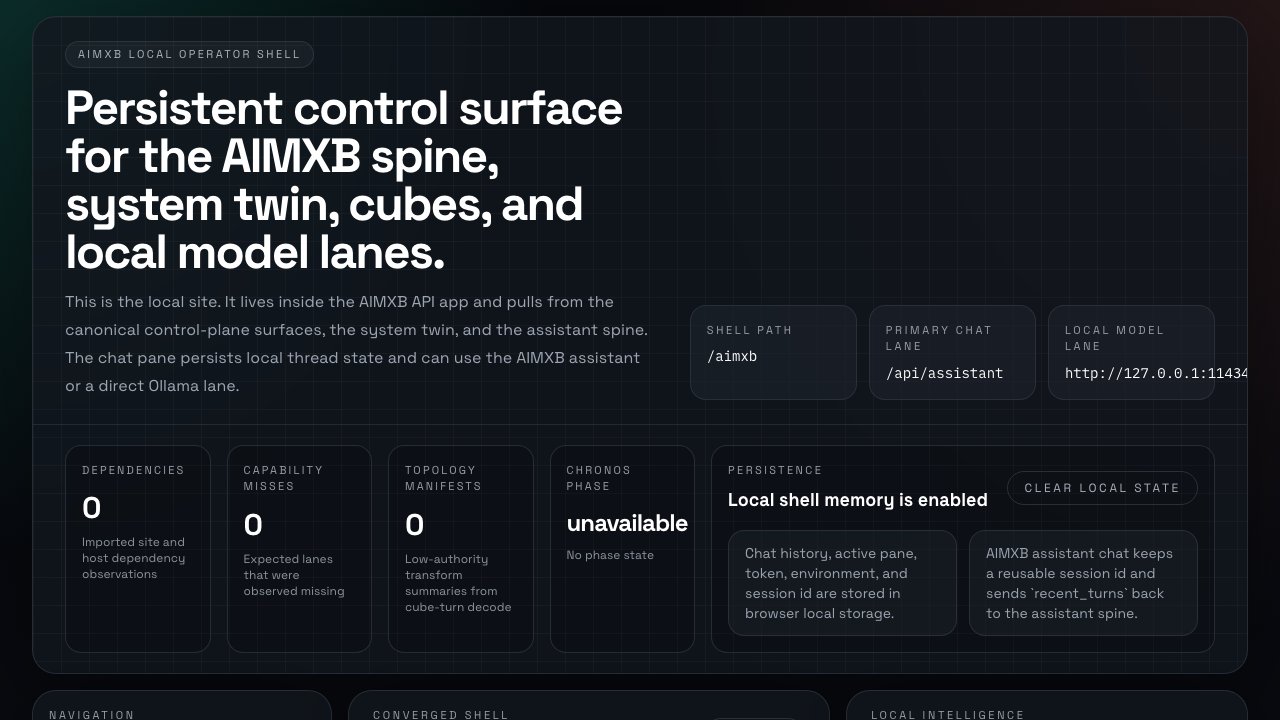
The public site can now point to an actual AIMXB-LAM surface: persistent control, memory, topology, and local model lanes running inside one operator shell.
Control
Operator panes, shell path, chat lane, and model lane are visible inside one governed environment.
Memory
The capture already shows local shell memory and session continuity rather than a stateless demo.
Topology
Ingress, recall, authority, action, and writeback are not theory alone; the capture now anchors the model.
Request A Briefing
Send the stack, the bottlenecks, the actors, and the first operating constraint. AIMXB will map the cleanest path from fragmented tools to a governed intelligence system.
Based in the U.S. · Global delivery