Start where coordination, visibility, or execution is breaking down.
Deployment
Launch from the operating pressure, not the mockup.
AIMXB starts by mapping actors, systems, commitments, thresholds, and failure points. The first surface follows that pressure.
Sequence the model, the controls, and the first release before expanding outward.
Launch the first surface as the edge of the system, not as another isolated project.
Release Sequencer
Deployment changes shape depending on where the operating pressure is actually concentrated.
This view shows how AIMXB chooses a first release: by constraint, not by whichever surface seems easiest to draw.
Map pressure
Actors
Systems
Handoffs
Failure points
Map
Start by reading the business as an operating environment.
The first pass identifies the objects, actors, approvals, systems, and failure points already carrying the company so the release can target the real break.
Context first
before any build sequence is set
Runtime Surface
The deployment layer already has a runtime board.
AIMXB already renders services, dependencies, and recovery state inside the shell, which makes deployment a governed environment problem instead of a blind handoff.
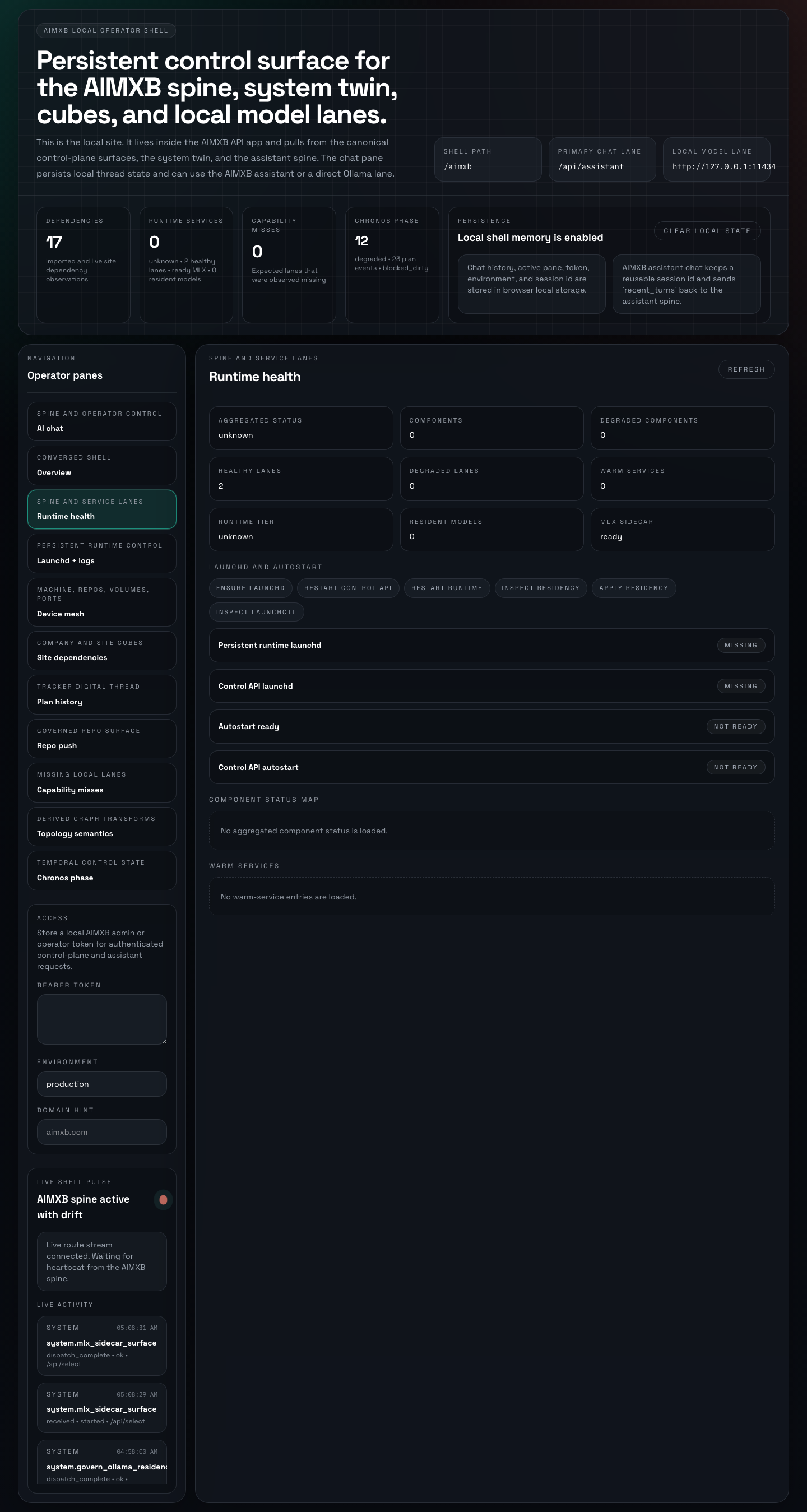
Runtime
Services stay readable during release.
The shell exposes runtime status, listener count, degraded lanes, and component state without leaving the operating surface.
Controls
Recovery actions sit beside the board.
Reset, inspect, launch, and dependency actions remain in the same release lane instead of falling into an external ops gap.
Expansion
Each new surface can inherit the same release path.
Once the sequence is governed at the shell level, the next environment inherits the pattern instead of being redeployed from scratch.
Deployment Sequence
Release follows the sharpest constraint.
The first flagship, access surface, workspace, or application should remove the main bottleneck and establish the pattern for what expands next.
01
Map the operating model
Identify the entities, states, responsibilities, approvals, constraints, and failure points already driving the business.
02
Bind records and workflows
Connect the stack so signals, history, and actions can move through one governed environment.
03
Define control points
Attach role boundaries, approval gates, logging, and intervention paths before the system starts acting.
04
Launch the first surface
Open the flagship, portal, workspace, or application that gives the right audience immediate value.
05
Expand from the core
Launch the next surface faster because the system, governance, and operating model already exist.
Deployment Fit
The first release format follows the constraint.
AIMXB chooses the opening surface by where continuity, authority, and visibility improve fastest once the model is in place.
01
Use the flagship when the company itself needs a sharper operating front door.
This is the right first move when partners, customers, or the market need a clearer system thesis and a better entry into the company before deeper task surfaces open.
02
Use an access surface when a specific audience needs focused entry, status, and requests.
This fit is strongest when a defined user group needs identity, reporting, communication, and controlled interaction with the operating model without carrying the whole company narrative.
03
Use a private operator surface when approvals, exceptions, and routing are the actual constraint.
If the business is slowing down around decisions, assignments, and threshold handling, the first serious release should open where operators can govern the pressure directly.
04
Use a domain application when one workflow needs its own tightly bounded environment.
A domain release makes sense when one high-value path deserves a dedicated application, but still needs to inherit the same objects, controls, and action model as the rest of the system.