
Give the core business objects stable meaning so every surface reads the same company.
System
Build the operating model once. Let people and agents act through it.
AIMXB-LAM turns the business into an operational model of objects, properties, links, permissions, actions, and history. Analytics, workflows, operators, and AI all work against the same frame.
Define reusable actions against the model instead of scattering business logic across tools.
Keep permissions, approvals, thresholds, and audit rules attached to the object and the action.
System Architecture
The core is an operating model, not a reporting layer.
Business intelligence becomes operational when objects, actions, policy, and writeback stay inside the same system.
Accounts, people, properties, obligations, requests, vendors, and other business entities are modeled in one system.
History, open loops, ownership, and prior decisions stay attached to the object instead of getting scattered.
Approvals, overrides, workflows, and operator moves become reusable system actions instead of disappearing into tickets and email.
Automation, manual intervention, and escalation paths are explicit, role-aware, and auditable.
New logic, new workflows, and new surfaces can be added without breaking the shared operating model.
System Orbit
AIMXB-LAM keeps objects, lineage, actions, and policy inside one operating field.
Each lens below shows a different layer of the same intelligence core. The interfaces can change because the underlying model does not.
State graph
Accounts
Requests
Commitments
Assets
State
Objects hold the operating truth.
Accounts, obligations, requests, assets, and people stay modeled in one frame so the business can act against current condition instead of stale summaries.
State anchored
across every surface
Field Notes
System doctrine is now published alongside the platform language.
These notes sharpen the deeper AIMXB-LAM commitments: ontology before interface, governed action before automation, and evaluation before drift.
Field Note 01
Ontology
Ontology Before Interface
AIMXB starts by deciding what is real enough for the company to remember, relate, govern, and change. That is ontology.
Read noteField Note 02
Action
Governed Action Beats Clever Automation
A business does not become intelligent when it can describe itself. It becomes intelligent when it can act without losing authority, memory, or traceability.
Read noteField Note 08
Evaluation
Evaluation Discipline
A serious intelligence layer needs a discipline for scoring routes, checking outcomes, and tightening policy before failure becomes culture.
Read noteEvaluation Scorecard
The system scores itself before drift becomes culture.
AIMXB-LAM should not just route and act. It should keep grading whether those routes are admissible, reconstructable, and improving the institution they touch.
Correctness
92The route still has to match reality.
The system checks whether the recommendation, classification, or escalation actually fits current state.
Admissibility
96The action has to be allowed.
Permissions, policy thresholds, and role boundaries are scored before the verb gets applied.
Trace quality
93The decision has to stay reconstructable.
Evidence, route, and outcome must remain legible enough for the next operator to understand what happened.
Handoff quality
89The next actor has to inherit context, not residue.
AIMXB scores whether the next person, system, or surface received the right operating context.
Policy reaction
Weak routes trigger correction.
Evaluation should change thresholds, approval rules, or route design instead of sitting in a report.
Meta layer
The reflective loop stays operational.
Self-modeling matters only when the system can see where it is weak and force tighter behavior.
Institutional fit
The score belongs to the business, not just the model.
A strong route is one the institution should continue to trust under pressure, not one that only looks efficient.
Business Translation
What the operating model changes in practice.
The public language can stay simple. Underneath, the system keeps shared context, grounded actions, and synchronized surfaces.
01
Shared state
Teams and systems stop working from competing spreadsheets, portals, and assumptions.
02
Less reconciliation
Approvals, changes, and outcomes stay tied to the operating model instead of being reconstructed later.
03
Faster expansion
New surfaces launch from an existing intelligence layer, not from another disconnected implementation.
Meta Layer
The system must know when not to trust itself.
AIMXB-LAM becomes serious when confidence, authority, and consequence determine whether a route stays automatic, moves to review, or forces a policy correction.
Signal ingress
A new signal enters the operating field.
History attached
Policy check
Route scored
Every recommendation starts as a candidate route, not an entitlement to act. The meta layer scores consequence before the verb survives.
Auto route
High confidence / low consequenceThe system can move directly when the path is clear.
Low-risk work with strong object state and clean policy fit can stay automated inside the admissible boundary.
Context intact
Policy matched
Writeback ready
Operator review
Ambiguous or context-heavyHuman review enters when interpretation matters.
Sensitive exceptions, partial evidence, or conflicting history route into a reviewed decision instead of false certainty.
History surfaced
Authority visible
Escalation prepared
Policy hold
Threshold or rule conflictThe system stops when authority is not yet admissible.
If the route crosses a money, service, or governance threshold, the action pauses until the right authority intervenes.
No silent override
Hold with trace
Higher review
Model correction
Repeated failure patternThe route gets redesigned when the distinction itself is weak.
When the same class of failure repeats, the meta layer forces ontology, policy, or evaluation changes rather than normalizing the miss.
Evaluation loop
Policy tightening
Ontology repair
Confidence
Confidence is not permission.
A route can look strong and still remain inadmissible under current authority.
Escalation
Escalation preserves trust.
A serious system protects institutional trust by surfacing ambiguity instead of concealing it behind speed.
Correction
Stops are productive.
A stop that reveals a weak distinction is better than a smooth error the business learns to tolerate.
Runtime Evidence
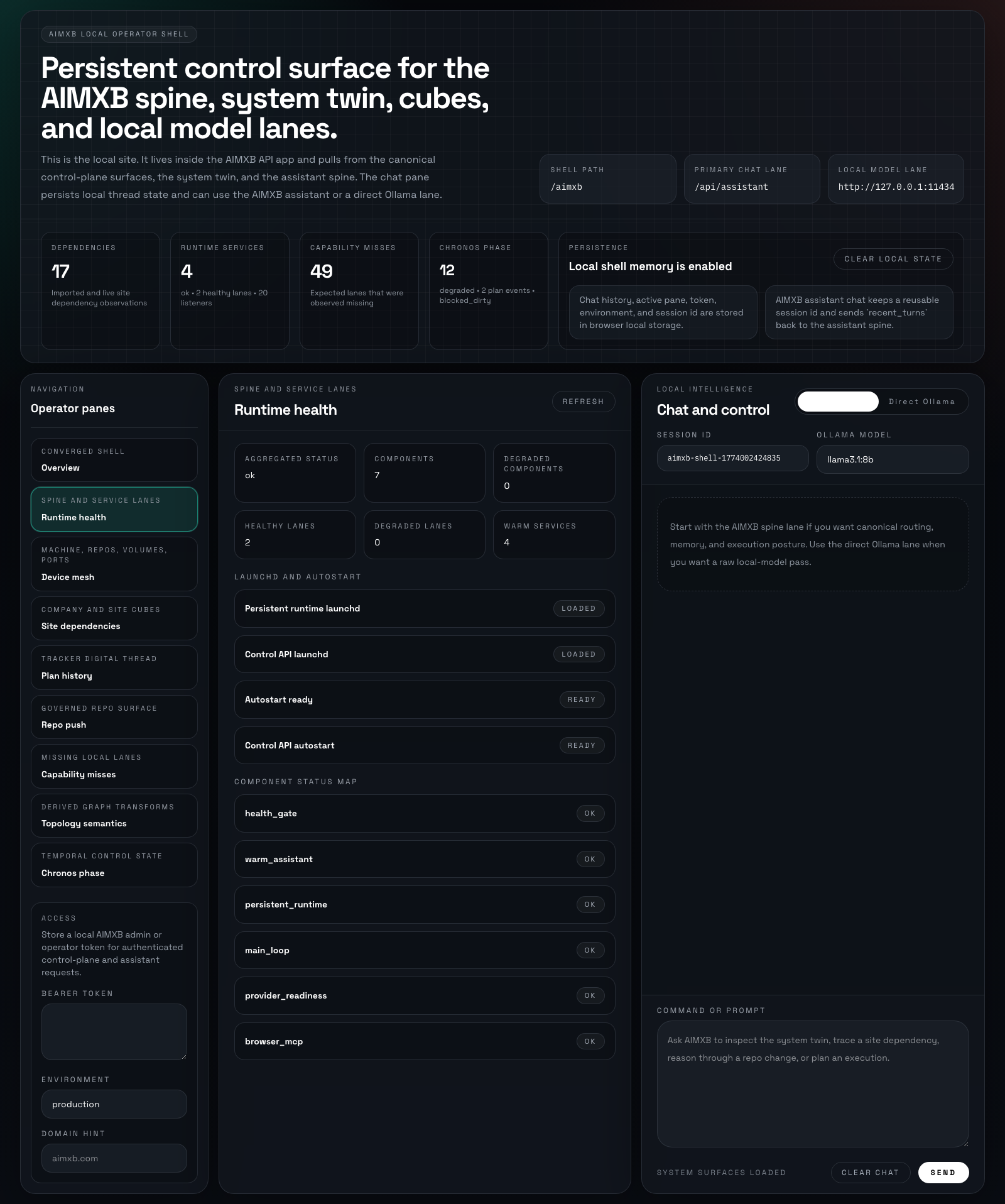
The reflective loop already sits inside a working AIMXB shell.
This capture shows the runtime health surface tracking service state, degraded lanes, launch condition, and command entry inside the same operator environment.
Observe
Signal starts with actual runtime state.
Component counts, lane status, and service condition are already visible in one operating surface.
Score
The scoring logic now has a product anchor.
Confidence, degradation, and readiness can be framed against a live runtime surface instead of abstract copy.
Repair
Correction remains part of the system.
The SVG loop now lands against a shell that already exposes service health and intervention paths.